
Brazil is one of the world’s major poultry-producing and exporting countries, making Brazilian frozen chicken products an important sourcing option for international importers. For Chinese food importers, wholesalers, distributors, restaurant suppliers and foodservice companies, Brazilian chicken paws and chicken feet can be attractive products because of established poultry-processing infrastructure, export experience and strong demand across Asian markets. Can I Import Grade A Brazilian Chicken Paws into China
But can you import Grade A Brazilian chicken paws into China?
Yes, Brazilian poultry products can be exported to China when the product, exporting establishment, documentation and shipment comply with the applicable Chinese and Brazilian regulatory requirements. Importers should not assume that every Brazilian poultry supplier or every processing plant is automatically eligible for China. Establishment authorization, product eligibility, sanitary certification, customs requirements and cold-chain compliance must be confirmed before shipment.
For buyers searching for Brazil chicken feet suppliers, frozen chicken feet from Brazil, Brazilian chicken paws suppliers China, or frozen chicken feet from Brazil to China, the most important issue is choosing a supplier capable of supporting the complete export process rather than simply offering a low price.
VIBRA AGROINDUSTRIAL S/A – Brazilian Frozen Chicken Supplier
Can I import Grade A Brazilian chicken paws into China?
Chinese importers can source Brazilian chicken paws when the shipment satisfies the applicable Chinese import controls and the exporting establishment is properly authorized for the relevant product and market.
The Brazilian Ministry of Agriculture and Livestock (MAPA) explains that establishments registered under Brazil’s Federal Inspection Service (SIF) may require additional authorization when exporting to countries with specific market requirements. For countries such as China, exporters must follow the applicable country-specific habilitation and certification procedures.
This distinction is extremely important.
A company may be a legitimate Brazilian poultry business, yet that does not automatically mean that a particular facility, product category or shipment can enter China. Chinese importers should therefore verify the exporter and establishment against the current applicable requirements before signing a large purchase contract.
For a buyer, the practical process should begin with five questions:
- Is the Brazilian processing establishment properly registered and authorized?
- Is the establishment eligible to export the specific chicken product to China?
- Does the product meet the agreed Grade A commercial specifications?
- Can the exporter provide the required sanitary and commercial documentation?
- Can the shipment maintain the required frozen cold chain from Brazil to the Chinese destination?
These questions are more important than simply asking for the cheapest Brazil chicken feet wholesale price.
Why import frozen chicken paws from Brazil?
Brazil has developed a large-scale poultry industry supported by integrated production, processing, quality control and international logistics. Brazilian exporters serve customers across multiple global markets, making Brazil an established sourcing origin for frozen chicken.
For Chinese buyers, Brazilian chicken paws can be particularly interesting for several reasons.
1. Strong poultry-processing infrastructure
Large Brazilian poultry operations can supply multiple chicken cuts from the same production chain. This creates opportunities for importers to purchase chicken paws alongside other products such as wings, drumsticks and breast meat.
2. International export experience
Brazilian poultry exporters routinely work with international documentation, inspections, frozen logistics and overseas buyers.
3. Competitive bulk sourcing
Wholesale buyers can negotiate according to volume, packaging, destination port, product specifications and payment terms.
4. Product variety
Importers can build mixed purchasing programs around several frozen chicken products instead of depending on a single SKU.
5. Asian market demand
Chicken feet and paws are widely used in Asian foodservice and food-processing markets. Depending on the market and local culinary preferences, they can be prepared in dim sum, braised dishes, soups, hot pots, snacks and other recipes. Can I Import Grade A Brazilian Chicken Paws into China
What are Grade A Brazilian chicken paws?
“Grade A” is commonly used in international poultry trading to describe chicken paws meeting a buyer’s agreed physical and quality specifications. However, importers should not treat the phrase as a substitute for official Chinese regulatory approval.
Commercial Grade A specifications can include characteristics such as:
- Clean and properly processed paws
- White or clean skin
- Yellow outer skin removed where specified
- Nails removed
- No feathers
- No excessive blood
- No bad odor
- No significant bruising
- No black pads
- No ammonia burns
- Limited broken bones
- Controlled moisture
- Appropriate individual piece size
- Proper freezing
- Suitable export packaging
- Traceability and lot identification
Vibra’s published product information describes frozen chicken paws with specifications including cleaning, removal of yellow skin, absence of feathers, bruises and black pads, and controls concerning broken bones and moisture.
Because specifications can vary by contract, importers should always request a current product specification sheet before purchasing.
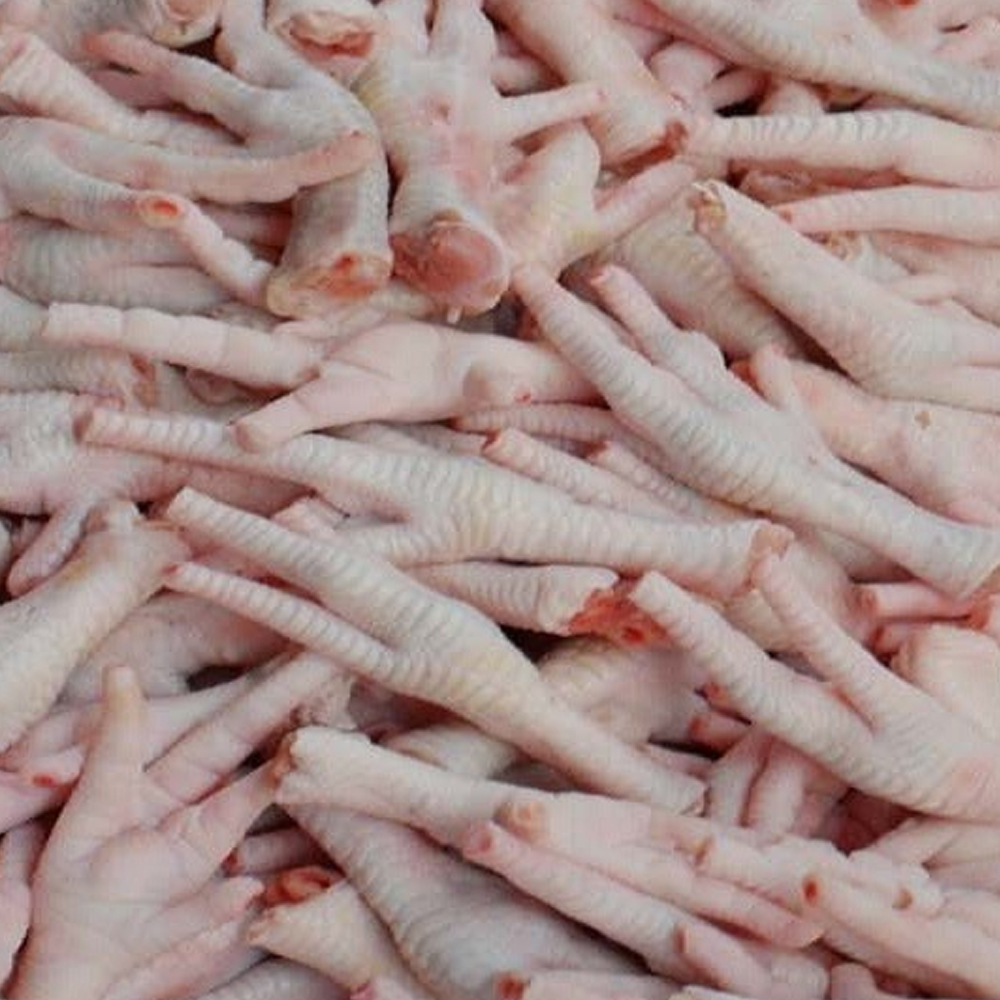
Brazilian chicken paws specifications buyers should request
A professional importer should request a complete specification sheet rather than relying on a product title such as “Grade A.”
Important specifications include:
| Specification | What the buyer should confirm |
|---|---|
| Product | Frozen chicken paws/feet |
| Origin | Brazil |
| Grade | Grade A or agreed commercial grade |
| Piece weight | Buyer-specific range |
| Length | Buyer-specific range |
| Skin | Clean and properly processed |
| Nails | Removed where specified |
| Feathers | Not permitted |
| Bruises | Controlled according to specification |
| Black pads | Not permitted |
| Ammonia burns | Not permitted |
| Broken bones | Contract specification |
| Moisture | Contract specification |
| Freezing | Approved commercial freezing process |
| Storage | Frozen cold-chain conditions |
| Packaging | Agreed carton/polybag configuration |
| Shelf life | Confirmed on current specification |
| Certification | Applicable export and sanitary documentation |
| Labeling | Chinese import requirements |
A current third-party listing associated with Vibra describes Grade A frozen chicken feet/paws with a piece weight of approximately 30 grams or more and other physical specifications. Other published trade listings associated with the supplier describe 35–45 gram pieces and 9–12 cm lengths. Because specifications can differ between listings and contracts, buyers should obtain the current commercial specification directly before placing an order. Can I Import Grade A Brazilian Chicken Paws into China
Frozen chicken feet vs frozen chicken paws
The terms chicken feet and chicken paws are often used interchangeably in international trade, although terminology can vary between suppliers and markets.
For purchasing purposes, buyers should focus on the exact physical product being offered.
Ask the supplier:
- Does the product include the complete foot?
- Where is the foot cut?
- Are nails removed?
- Is yellow skin removed?
- What is the average piece weight?
- What is the permitted broken-bone percentage?
- What moisture specification applies?
- What is the freezing method?
- What is the carton configuration?
- What is the net and gross weight?
- What is the shelf life?
This prevents misunderstandings between buyer and seller.
How to buy frozen chicken feet from Brazil for China
The process should be treated as an international food-import transaction rather than a simple wholesale purchase.
Step 1: Define the product
Before requesting a quotation, specify exactly what you want.
For example:
Product: Grade A frozen chicken paws
Origin: Brazil
Market: China
Packaging: 20 kg cartons or agreed format
Piece weight: According to buyer specification
Freezing: Commercial frozen product
Destination: Chinese port
Quantity: Full container or agreed bulk volume
The more precise the specification, the easier it is for suppliers to quote accurately.
Step 2: Verify the Brazilian supplier
Research the company, processing facility, export credentials and product portfolio.
Vibra’s online product portfolio includes frozen chicken feet, chicken paws, breast, drumsticks and wings, providing buyers with the possibility of sourcing multiple poultry cuts from one supplier.
The company’s published website states that its products are subject to Federal Inspection Service oversight and identifies international export activities.
Nevertheless, importers should independently verify the establishment’s current eligibility for the specific Chinese market and product before shipment.
Step 3: Verify China eligibility
This is one of the most important steps.
MAPA maintains China-specific information covering procedures for habilitation and certification of establishments exporting products of animal origin. The Chinese market can impose requirements beyond ordinary Brazilian SIF registration.
The buyer should therefore work with the exporter and Chinese customs/import authorities to verify:
- Exporting establishment eligibility
- Product eligibility
- Applicable sanitary protocol
- Chinese registration requirements
- Required health certificate
- Customs classification
- Labeling requirements
- Inspection and quarantine requirements
- Import licensing or permits where applicable
Step 4: Request a quotation
A professional quotation should clearly state the commercial basis.
Ask whether the quoted price is:
- EXW
- FOB
- CFR
- CIF
- Or another agreed Incoterm
The quotation should also identify:
- Product
- Grade
- Origin
- Quantity
- Packaging
- Price
- Loading port
- Destination port
- Payment terms
- Lead time
- Documentation
- Inspection arrangements
Never compare two quotations based solely on the price per metric ton if their specifications and Incoterms are different.
How much do Brazilian chicken paws cost?
There is no single fixed international price for Brazilian frozen chicken paws.
The final price can change according to:
- Product grade
- Piece size
- Quantity
- Season
- Supply availability
- Packaging
- Brazilian loading port
- Destination port
- Freight
- Insurance
- Exchange rates
- Chinese import costs
- Inspection charges
- Payment terms
- Contract duration
Published online trade listings can provide indicative market information, but they should not be treated as a guaranteed current quotation. For example, one recent marketplace listing associated with Vibra showed an indicative Grade A frozen chicken feet price, while other marketplaces publish different estimated ranges.
For a serious importer, the best approach is to request a current quotation based on the exact quantity and Chinese destination.
Packaging of frozen Brazilian chicken paws
Packaging is a critical part of frozen poultry importing.
A commonly advertised configuration for Brazilian chicken paws is a 20 kg carton, sometimes divided into four 5 kg polyethylene bags. Published trade information associated with Vibra also describes this type of packaging.
However, packaging should always be confirmed before purchase because buyers may require:
- Different carton weights
- Private labels
- Chinese-language labels
- Retail packaging
- Foodservice packaging
- Bulk industrial packaging
- Different bag configurations
The carton should be suitable for frozen international transport and clearly identify the product, lot and relevant traceability information.
Cold-chain requirements for frozen chicken feet from Brazil to China
Cold-chain management is essential.
Frozen chicken paws should remain under controlled frozen conditions throughout:
Processing → freezing → cold storage → container loading → ocean transportation → Chinese port → customs clearance → destination warehouse
Temperature deviations can negatively affect product quality and may create regulatory or commercial problems.
Buyers should discuss:
- Freezing temperature
- Storage temperature
- Container temperature
- Temperature monitoring
- Loading procedures
- Transit time
- Port handling
- Contingency procedures
- Destination cold storage
Some published Vibra-associated specifications describe blast freezing at approximately -40°C and storage at approximately -18°C. These figures should be treated as product-specific commercial information and confirmed against the current supplier specification and applicable Chinese requirements. Can I Import Grade A Brazilian Chicken Paws into China
Documentation required for Chinese importers
Documentation depends on the product, establishment, applicable protocol and current Chinese rules.
Potential documents can include:
- Commercial invoice
- Packing list
- Bill of lading
- Certificate of origin
- Veterinary/sanitary certificate
- Export documentation
- Product specification
- Health documentation
- Establishment information
- Import registration documentation
- Customs documentation
- Container and seal information
- Other documents required by Chinese authorities
MAPA’s China page provides country-specific procedures for animal-origin exports, including updated procedures for habilitation and certification.
Chinese importers should coordinate with their customs broker and the relevant Chinese authorities before shipment rather than discovering documentation requirements after the container has departed Brazil.
Is GACC registration important?
Yes.
China’s General Administration of Customs of China (GACC) plays a central role in the registration and supervision of overseas food establishments.
The exact registration mechanism depends on the product category and applicable Chinese rules. Importers should therefore verify the current GACC status of the relevant Brazilian establishment and product before contracting.
MAPA’s China guidance specifically provides information on GACC-related procedures and establishment registration for products destined for China.
Importers should not assume that an exporter is approved merely because the company advertises “GACC” online. Always request verifiable registration information and confirm it through the applicable official channels.
Why Chinese importers should work with experienced Brazil chicken feet suppliers
Choosing an experienced supplier can reduce transaction risk.
A reliable supplier should be able to discuss:
Product quality
The supplier should understand the physical specifications required by the Chinese buyer.
Export documentation
The supplier should have experience preparing international shipment documents.
Cold-chain logistics
The supplier should understand frozen container loading and temperature control.
Production planning
The supplier should provide realistic production and loading schedules.
Traceability
The supplier should be able to identify production lots and relevant documentation.
Communication
Large poultry transactions involve multiple stages, so reliable communication is essential.
Long-term supply
Distributors often need recurring shipments rather than one-off purchases.
Why buy other Brazilian frozen chicken products?
Chinese importers purchasing chicken paws may also consider a wider frozen poultry portfolio.
For example, buyers may combine chicken paws with breast meat, drumsticks and wings depending on their distribution channels.
Frozen chicken breast
Chicken breast is widely used by supermarkets, food processors, restaurants, hotels and foodservice distributors.
Frozen Chicken Breast – VIBRA AGROINDUSTRIAL S/A
Frozen chicken 2-joint wings
Two-joint chicken wings can be supplied to restaurants, foodservice distributors and food processors.
Frozen Chicken 2 Joint Wing – VIBRA AGROINDUSTRIAL S/A
Frozen chicken 3-joint wings
Three-joint wings can serve different wholesale and foodservice applications.
Frozen Chicken 3 Joint Wing – VIBRA AGROINDUSTRIAL S/A
Frozen chicken drumsticks
Drumsticks are another popular frozen poultry product for distributors and foodservice buyers.
Frozen Chicken Drumstick – VIBRA AGROINDUSTRIAL S/A
Frozen chicken feet
For buyers specifically searching for Brazilian chicken feet suppliers, Vibra’s frozen chicken feet product page provides a dedicated sourcing option.
Frozen Chicken Feet – VIBRA AGROINDUSTRIAL S/A
Frozen chicken paws
Buyers specifically looking for paws can also review the dedicated product listing.
Frozen Chicken Paws – VIBRA AGROINDUSTRIAL S/A
What should Chinese importers ask Brazilian chicken paws suppliers?
Before placing an order, send the supplier a detailed purchasing request.
A useful RFQ should include:
Product: Grade A Frozen Chicken Paws
Origin: Brazil
Destination: China
Quantity: ___ metric tons
Piece weight: ___ grams
Length: ___ cm
Packaging: ___ kg/carton
Required shelf life: ___ months
Incoterm: FOB/CFR/CIF
Destination port: ___
Payment: T/T or L/C, subject to agreement
Required documents: Full export and sanitary documentation
Inspection: Independent inspection if required
Then ask the supplier to provide:
- Current product specification
- Product photos
- Packaging photos
- Carton dimensions
- Net weight
- Gross weight
- Pallet information
- Container loading information
- Current production availability
- Lead time
- Export establishment details
- Applicable certifications
- China-market authorization information
- Current quotation
This creates a much clearer basis for comparing suppliers.
How to avoid problems when importing Brazilian chicken paws
Do not purchase based only on photographs
Images cannot establish product grade, moisture, broken-bone percentage or regulatory eligibility.
Do not assume every Brazilian supplier can export to China
Market authorization is product- and establishment-specific.
Do not ignore Chinese labeling requirements
Your customs broker and importer should confirm the exact labeling requirements before shipment.
Do not accept vague specifications
“Premium chicken paws” is not enough. Define the actual product characteristics in the sales contract.
Do not overlook cold-chain logistics
A low product price can become expensive if the shipment suffers delays or temperature problems.
Do not send a large payment before performing appropriate due diligence
Verify the company, contract, banking details, documentation and agreed transaction terms.
Do not rely on outdated GACC information
China’s import requirements can change. Verify the current rules and registration status before every new long-term supply program.
Is Brazilian chicken paw import suitable for restaurants and distributors in China?
For companies already serving Chinese foodservice and wholesale markets, frozen chicken paws can be an attractive category.
Potential customers include:
- Restaurant distributors
- Dim sum suppliers
- Asian food wholesalers
- Meat importers
- Supermarket distributors
- Foodservice companies
- Catering businesses
- Food processors
- Frozen-food wholesalers
- Regional poultry distributors
The commercial opportunity depends on local demand, import costs, product specifications and the buyer’s distribution network.
Why product consistency matters
For a distributor, consistency can be more valuable than a one-time low price.
A good long-term supplier should aim to maintain consistent:
- Piece size
- Cleaning
- Skin appearance
- Packaging
- Moisture
- Freezing quality
- Carton weight
- Documentation
- Shipment timing
Consistency allows distributors to establish predictable purchasing programs and reduce complaints from downstream customers.
Brazil chicken feet suppliers for long-term contracts
Large importers may benefit from discussing annual or recurring supply agreements.
A long-term contract can potentially cover:
- Monthly volume
- Quarterly volume
- Product grade
- Packaging
- Price formula
- Shipment schedule
- Destination ports
- Inspection
- Payment terms
- Quality claims
- Documentation
- Force majeure
- Product rejection procedures
However, both parties should ensure the contract reflects the actual regulatory requirements of the Chinese market.
How to compare Brazilian chicken paws suppliers
A useful supplier comparison should look beyond price.
| Factor | Supplier A | Supplier B | Supplier C |
|---|---|---|---|
| Brazil origin | ✓ | ✓ | ✓ |
| Grade A specification | ✓ | ✓ | ✓ |
| China eligibility verified | ✓ | ? | ? |
| GACC status verified | ✓ | ? | ? |
| SIF establishment | ✓ | ✓ | ✓ |
| Product specification | ✓ | ✓ | ? |
| Packaging specification | ✓ | ✓ | ✓ |
| Cold-chain plan | ✓ | ? | ✓ |
| Export documentation | ✓ | ✓ | ? |
| Inspection option | ✓ | ? | ✓ |
| Long-term supply | ✓ | ✓ | ? |
| Price | Compare | Compare | Compare |
The cheapest supplier is not necessarily the best supplier.
For Chinese importers, a slightly higher price from a properly documented and reliable exporter can be preferable to a low quotation that creates customs, quality or delivery problems.
Frequently asked questions
Can I import Grade A Brazilian chicken paws into China?
Yes, provided the product and exporting establishment meet the applicable Chinese import requirements and the shipment is supported by the required documentation and sanitary certification. Importers should verify the current eligibility of the specific establishment and product before shipment.
Are Brazilian chicken feet popular in China?
Chicken feet and paws are established products in Asian food markets, including China. Their culinary applications include dim sum, braised dishes, soups and other preparations.
What is the difference between chicken feet and chicken paws?
The terms are frequently used interchangeably in international poultry trading. The exact cut and processing specification should be defined in the purchase contract.
What does Grade A chicken paws mean?
It generally refers to a commercial quality specification covering appearance, cleaning, size and defects. The exact specification must be agreed between buyer and supplier.
What packaging is available?
A commonly advertised format is 20 kg cartons containing four 5 kg bags, but packaging can vary. Buyers should confirm the exact configuration before ordering.
What temperature should frozen chicken paws be stored at?
Frozen poultry requires controlled frozen storage. A supplier’s published specifications may specify approximately -18°C for storage, but importers should follow the product specification, shipping requirements and applicable regulatory requirements.
Can I buy Brazilian chicken paws in container quantities?
Yes, Brazilian poultry suppliers and international traders commonly structure frozen poultry sales around bulk quantities and container shipments. The exact loading capacity depends on packaging, container type, weight limits and logistics.
Can I import chicken feet and chicken wings in the same shipment?
This depends on the products, establishment authorization, Chinese import requirements, documentation and commercial logistics. The importer should confirm eligibility before combining products.
Should I inspect the goods before shipment?
For significant commercial purchases, buyers may consider independent inspection or agreed pre-shipment quality verification. The inspection scope should be written into the contract.
How do I get a price for frozen chicken paws from Brazil?
Send the supplier your required quantity, product specification, packaging, destination Chinese port and preferred Incoterm. This allows the exporter to calculate a more meaningful quotation.
Final checklist for Chinese importers
Before confirming a purchase of Brazilian frozen chicken paws, verify:
Supplier
- Legal company identity
- Processing establishment
- SIF registration
- Export experience
- China-market eligibility
Product
- Grade
- Piece weight
- Length
- Cleaning
- Skin
- Nails
- Feathers
- Bruises
- Broken bones
- Moisture
- Freezing specification
Packaging
- Carton weight
- Bags per carton
- Carton dimensions
- Labeling
- Lot identification
- Net and gross weight
Shipping
- Loading port
- Destination port
- Container type
- Cold-chain requirements
- Transit plan
- Insurance
Documentation
- Commercial invoice
- Packing list
- Bill of lading
- Certificate of origin
- Sanitary/veterinary certificate
- Required Chinese import documentation
- Establishment registration information
Commercial
- Price
- Incoterm
- Payment terms
- Minimum order quantity
- Lead time
- Inspection
- Claims procedure
Conclusion: sourcing frozen chicken feet from Brazil to China
So, can I import Grade A Brazilian chicken paws into China? The answer can be yes, but successful importing depends on regulatory compliance, approved supply channels, product specifications, documentation and cold-chain management.
For Chinese importers, the ideal approach is to work with an established Brazilian poultry supplier that can provide detailed specifications and export documentation while allowing the buyer and its customs representatives to verify current China-market eligibility.
Vibra Agroindustrial S/A presents a portfolio of frozen chicken products including chicken feet, chicken paws, breast, wings and drumsticks. Its published materials describe international poultry operations and quality-control procedures, while its frozen chicken portfolio provides buyers with options beyond chicken paws.
For buyers specifically sourcing Brazil chicken feet suppliers, Grade A frozen chicken paws, or frozen chicken feet from Brazil to China, the next step should be to request a current specification and commercial quotation based on your exact requirements.
Start by reviewing the supplier’s poultry portfolio:
VIBRA AGROINDUSTRIAL S/A – Frozen Chicken Supplier
Then review the dedicated product pages for frozen chicken feet, frozen chicken paws, frozen chicken breast, 2-joint wings, 3-joint wings, and chicken drumsticks to determine whether a broader poultry purchasing program could meet your distribution needs.
Before any shipment leaves Brazil, however, Chinese importers should confirm the latest GACC/MAPA requirements and verify the exporting establishment and product eligibility. MAPA’s China-specific animal-origin export guidance is updated periodically, making current verification an important part of the procurement process.
With the right supplier, clearly defined Grade A specifications, verified regulatory eligibility, complete documentation and reliable frozen logistics, Brazilian chicken paws can be considered as part of a professional China-focused poultry sourcing program.